Judy Hopps
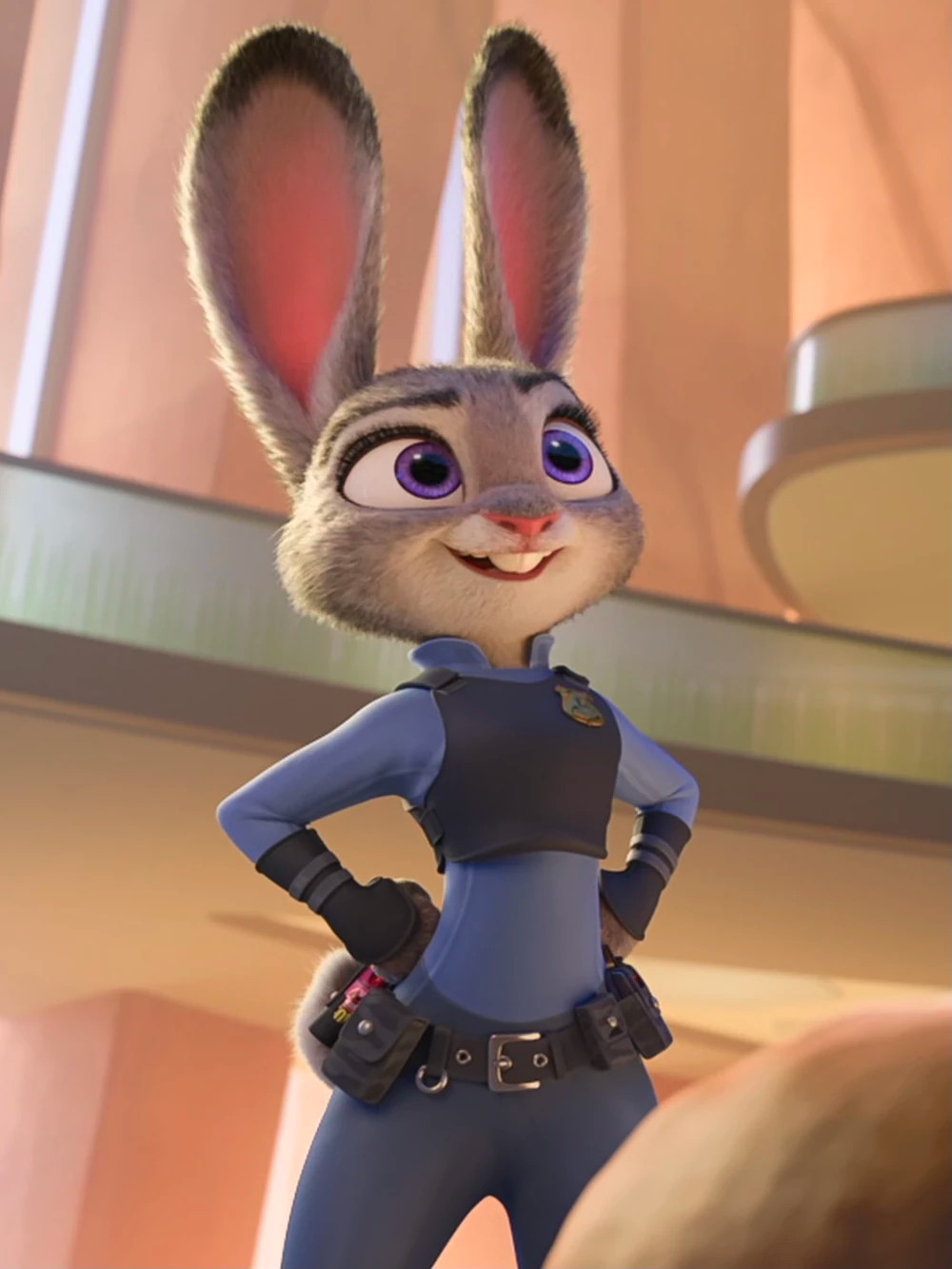
Judy Hopps is a rabbit and one of the four core members of the pack in We Can Fix Pawbert. She is the protagonist of the Zootopia franchise, where she became the first rabbit officer of the ZPD. In the series, Judy serves as the pack's moral compass and emotional anchor — the first mammal to advocate for Pawbert even after he poisoned her. She is married to Nick Wilde.
Judy Hopps is a rabbit and one of the four core members of the pack in We Can Fix Pawbert. The first rabbit officer in ZPD history, her moral clarity and determination define the pack's conscience.
"I love you, you ridiculous fox." — Judy to Nick, "Inferno"
Background
Early Life
Judy grew up in Bunnyburrow, a rural community far from Zootopia. Her parents, Stu and Bonnie Hopps, were carrot farmers who loved their daughter fiercely but discouraged her dream of becoming a police officer — a career no rabbit had ever pursued. As a child, Judy confronted a fox bully named Gideon Grey at a farm fair. Gideon clawed her cheek, but she still retrieved the stolen tickets he had taken from her friends. The incident left her with both a scar and an unspoken wariness of predators.
Despite her family's 275+ siblings and the constant chorus of voices telling her to settle, Judy never wavered. She was determined to prove that anyone could be anything.
Personality
Judy is fiercely optimistic, driven, and independent. She cares deeply about the well-being of others and has a moral clarity that rarely falters. Her optimism is not naive — it has been tested by bigotry, betrayal, and loss — but it endures because she chooses it, daily.
Key personality traits across the series:
- Optimistic but realistic — She has seen the worst mammals can do and still chooses hope
- Driven to a fault — Her determination can shade into overzealousness and impulsiveness
- Morally grounded — The pack's compass; first to forgive, first to advocate
- Emotionally honest — Capable of expressing her feelings in powerful, genuine ways
- Tactically intelligent — Relies on wits over physical strength; resourceful in crisis
- Project manager energy — Coordinates, organizes, and keeps things moving in peacetime and war
She has a mild, often unintentional prejudice toward predators that she actively works to overcome. This tension — between her idealism and her inherited biases — is part of what makes her advocacy for inter-species relationships so meaningful. She and Nick face ongoing speciesism as an inter-species couple.
Physical Appearance
Judy is a young adult rabbit with a lithe build, gray fur with a lighter underbelly, large purple eyes, a short pink nose, long ears with black tips, and a small tail. As a detective, she wears professional attire rather than the patrol uniform of her early career.
Film History
Zootopia
Judy graduated from the Zootopia Police Academy as valedictorian under Mayor Lionheart's Mammal Inclusion Initiative — the first rabbit officer in ZPD history. Assigned to Precinct 1, she was immediately relegated to parking duty by Chief Bogo, who doubted her capabilities.
She encountered Nick Wilde, a fox con artist who tricked her into buying a Jumbo-pop for his "pawpsicle" scheme. When she confronted him later, Nick mocked her ambitions and predicted she would wash out. Undeterred, Judy volunteered to find missing otter Emmitt Otterton, staking her career on a 48-hour deadline.
She blackmailed Nick into assisting by recording his admission of tax evasion on her carrot pen recorder. Their investigation led them through the Mystic Spring Oasis, the sloth-operated DMV, Mr. Big's territory (where Judy's earlier rescue of Fru Fru saved their lives), and into the Rainforest District, where jaguar Renato Manchas went savage during questioning. Judy saved Nick's life by cuffing Manchas's ankle to a lamppost.
They traced the savage predators to Cliffside Asylum, where Mayor Leodore Lionheart was secretly imprisoning them. After Lionheart's arrest, Judy made a critical mistake at a press conference: she suggested the savage behavior might be due to predators' "biology." Nick, devastated, returned his completed ZPD application and walked away.
As anti-predator discrimination spread, Judy resigned and returned to Bunnyburrow. There she discovered that "Night Howlers" were toxic flowers, not wolves. She returned to Zootopia, tearfully apologized to Nick — calling herself "just a dumb bunny" — and he forgave her, having kept her carrot pen all along.
Together they uncovered that Assistant Mayor Dawn Bellwether was the mastermind, weaponizing night howler serum to turn predators savage. In the Natural History Museum, they tricked Bellwether into a recorded confession by swapping her serum pellets with blueberries.
Judy was reinstated. Nick graduated as the ZPD's first fox officer, and Judy badged him at his ceremony. They became partners. Her words to him in their cruiser: she loved him.
Zootopia 2
By the time of the Zootennial Gala, Judy was a detective partnered with Nick. Their relationship was still rocky — Chief Bogo assigned them to mandatory therapy sessions with Dr. Fuzzby for "Partners in Crisis."
At the gala, Judy went undercover and met Pawbert Lynxley — a nervous, awkward lynx who made her laugh. She did not know he was a Lynxley.
When Gary De'Snake infiltrated the gala seeking the Lynxley Journal, chaos erupted. Gary kidnapped Milton and revealed the truth about the Lynxleys' century-old theft of the Weather Walls from Agnes De'Snake. The Lynxleys framed Nick and Judy for Gary's attack on Chief Bogo, making them fugitives.
Nick, Judy, Gary, and Nibbles Maplestick worked together to uncover the full conspiracy. Pawbert appeared to help them — and Judy genuinely liked him. Then, at the critical moment near the Weather Walls, Pawbert revealed his true nature:
He injected Judy with snake venom. He threw Gary into the snow to freeze. He stabbed Nibbles with venom. He attacked Nick, telling him Judy was dead.
Gary, absorbing Judy's body heat to revive himself, called out to Nick during his fight with Pawbert. Nick threw the antivenom pen down to Gary, who injected Judy. She survived.
The heroes recovered Agnes's original patent from Reptile Ravine. Captain Hoggbottom knocked Pawbert unconscious with a frying pan. The Lynxley family was arrested. Mayor Winddancer found his courage and helped bring them down.
Nick and Judy were cleared. Their partnership — and their relationship — emerged stronger. Nick's words: "Love you, partner."
Series History
Season 1: The Anchor
Judy reads Pawbert's charges in the snow outside the clocktower in The Weakest Lynx, the venom injection site on her neck still under white gauze. On the courthouse transport detail her paw keeps returning to that bandage without her consent. When Pawbert's muffled apology reaches her she shuts it down flatly, but the silence afterward is hers to break, and what she asks him is why. When he calls his family's indifference normal she refuses the framing — it is not, and it is not how families work — because she watched them walk past him at the arrest as though he were not there. Minutes later the transport is ambushed, and Judy puts her shoulder into a snow leopard's ribs as he lines up a shot at the cuffed lynx inside: a rabbit's body between an assassin and the mammal who poisoned her. That night she stands in the hallway with Nick and Luther while Pawbert comes apart on the other side of the door. Nobody opens it and nobody goes to bed.
Over the following days she runs the operational center. She leads Pawbert's first structured debriefing in The Blacklist, checks his intel against the seized Lynxley Holdings documents, and plans the Canal District raid that takes the enforcer Hackjaw. Alone with Nick on the porch she admits she has no settled position on any of it — she keeps touching her neck and cannot decide whether what she feels is anger, grief, or exhaustion. She does not resolve it. She keeps working. In The Eraser she designs the route that keeps the City Records warrant off the docket — a sealed application Bogo walks straight to a duty judge, so nobody inside the building learns of it until the team is already there — and reaches the vault in time to order Breck Clawmark away from his shredder and photograph the fabricated psychiatric evaluation built to destroy Pawbert's credibility; her interrogation afterward surfaces the case's next codename. She monitors comms through the Infrastructure Gala infiltration in The Architect, and tells Nick that night that whatever Luther is, the way he moved was not academy training — and that whoever he is, he is why Pawbert is still breathing.
The hit squad assault in Breach tests her under conditions nobody planned for. She covers the rear of the escape tunnel walking backward with her weapon drawn, and when Pawbert tries to turn back she takes his arm and gives him the hardest arithmetic available: if the attackers won, going back kills all of them and wastes everything Luther bought. At Site Two, with Luther flatlining on a work table, she drops to the floor beside Pawbert and pulls him back into the room by making him look at her. Sitting with him afterward she declines the comfortable version — she is not certain he is worth it, and is only starting to think Luther is right — before reframing the debt precisely: Luther did not stay behind because Pawbert was worth dying for, but because he was worth living for. She also puts the harder question to Bogo, and does not pretend to accept having been kept in the dark for her own protection.
Convalescence turns on a cardboard box. Bogo sends Pawbert's cleared personal effects out to Site Two by ZSI courier rather than through the precinct, because the leak that gave a kill team the last safehouse's address is still open. Judy carries the box in and sets it down in front of him. When he lifts his mother's green sweater out of it she sits beside him, leaving a deliberate gap, and calls it what the paperwork calls it — a sweater — which lets him correct her and say aloud what it actually is. The next morning, when he wears it into the hallway, she stops for exactly as long as it takes to tell him it suits him. When one of Nick's stories surprises a laugh out of Pawbert, she tells him not to apologize for it. In Home she joins the supply run that turns the warehouse into a home and offers Pawbert Nick's history as a parallel — a fox the city decided was one thing until he decided the city was wrong. Then she draws the distinction that governs her whole approach: the detail is not keeping him alive, it is keeping him safe.
The Mosaic investigation in Clear Skies asks her to hold two things at once. When Pawbert swears he knew nothing of his father's blackmail arm she says she believes him before he has finished arguing for it, and when Luther produces the sealed file with Pawbert's name on the cover she becomes conspicuously interested in a folder across the room until the photographs are ash. She also watches Nick handle a leverage tile from his own hustling years, and asks him quietly, once, whether he is all right. On the back porch that night she tells Pawbert she was once so intent on proving herself she nearly ruined everything, and when he says it must be nice to have someone, she sits on his other side and tells him he has people now too. In The Vault she reads the banker's sudden leave of absence as flight, presses for the raid to go in on a warrant rather than on urgency, and refuses his demand for immunity the moment he makes it.
The crossovers widen her role without changing its shape. She calls in the Canyonlands fire in Station 118 while Nick and Luther are still inside, holding Pawbert steady while watching those windows with the stomach she is telling him not to have. That night she produces a recipe card in Lillian Lynxley's penmanship from evidence return and hands it over without ceremony. At Precinct 99 she and Amy Santiago recognize each other on sight over color-coded binders and contingency plans; she brings Pawbert in as the only mammal who can validate the courier's ledgers, and it is Judy who links a fixer's codename to the arson that nearly killed Perry Stackwell. During the Halloween Heist she and Amy run a probability model that calls Nick's sabotage attempt to the minute, and when Amy hands her a personalized binder afterward she says, without armor, that it is the kindest gift anyone has given her.
Her position shifts from professional advocate to pack member across the season's middle stretch. She has the overnight watch at the safehouse in Stay, and in the morning she stops at the kitchen doorway before going in, a threshold habit she has trained into herself around him. Over the case files she and Nick both notice that his answers are correct and empty, and settle it between them in a glance neither explains; when Pawbert and Luther turn up at the table the following morning looking exhausted and altered, she asks once whether everyone is all right and then leaves it alone. When Pawbert and Luther emerge from the same room in Soft Launch she is caught mid-sip and only half succeeds at not laughing, and concedes that they had money on the timing. Her real contribution comes at the table afterward, when she squeezes Pawbert's paw and tells him to get used to it, because "this is what pack looks like." In Second Chances she takes the call from Precinct 7 and decides on the spot that Pawbert is coming with them, converting him from protected witness into operational asset. She clears rooms alongside Lucy Chen with a fluency neither has earned by training together, and afterward the two of them trade the same career in a corridor — the first rabbit in the ZPD and a rookie under Tim Bradford, both tired of proving themselves and both unwilling to be handed anything instead.
The Words is the season's fulcrum for her. Judy asks whether Pawbert has ever properly apologized, proposes that Dr. Fuzzby facilitate, and makes the call. In the session she takes his account of the premeditated venom without interrupting, her paw closing into a fist on her knee. She tells him she is not going to forgive him — not out of anger, but because forgiveness is not hers to give right now and may never be. Then she describes what he did to her, which nobody else in the room can: that she could not move or call for help, that she lay feeling her own body betray her, and that the only thought she could hold was Nick finding her without knowing what had happened. She names the injury underneath the physical one: she has spent her life refusing to be helpless, and he took that from her in minutes. In its place she offers the distinction the rest of the series is built on: she cannot forgive, but she can choose to see who he is becoming rather than only who he was, because an officer who does not believe mammals change has no ground to stand on. She closes by telling him to prove her right.
When cooperating witnesses begin dying in Quietus, Judy reads the third note as almost word-for-word the other two, and asks for the BAU before Bogo names the unit, and Bogo makes her and Nick liaison to the arriving ZSI-BAU team. She works the seized Lynxley therapy records with JJ Jareau until Dr. Silris Mawl surfaces, and states what his years of intake assessments gave him: every vulnerability, every lever. When the plan resolves into routing the killer to Pawbert through a seeded line, she names it bait — then authors one of the counter-scripts he carries into the call, that he makes it right by telling the truth. Through the call in I Choose to Stay her restraint is the contribution: she catches Nick's arm when he starts forward, because intervening would take the fight from the only mammal who can win it. When the trace lands she rides out with the entry team and cuffs Mawl in his apartment, laying out the evidence — the appointments in his calendar, the referrals through his foundation, the trace. When he calls it helping them, she corrects him without raising her voice.
On Pawbert's twenty-fifth birthday in Green Candle she answers his instinct to disappear: his being alive is not trouble. She gives him a cloth-bound notebook for recording small choices and recipes, names his dread as conditioning rather than prophecy, and sets the green candle in the cake herself. When Bogo orders a stand-down in Mandated Joy she relays it along with Fuzzby's written instruction to mandate joy. Trial preparation in Counsel turns on her bookkeeping: she counts the objections the prosecutor should have made and did not, six against two by the first recess and eleven against six by day's end, and supplies the detail the Pearson Specter Litt team actually needs — that she watched Grazella and defense counsel talking in a corridor like colleagues rather than opponents. Under Harvey Specter's mock cross-examination in Moot she refuses to be moved off facts and onto feelings, holds accountability and rehabilitation together as compatible rather than opposed, and inverts the charge that a near-victim cannot be impartial: setting it aside is what should let a jury trust her.
Judy testifies twice in The Trial — for the prosecution, then at Pawbert's sentencing. Her impact statement accounts for the venom, the months of recovery, and the mornings that still open with a question about whether she is alive, and she tells the court she cannot forgive and that the scar will not let her forget. What she can report is what she has watched since: weight carried, not performance staged. Her conclusion asks the court to widen what counts as accountability: the sentence is one form, the testimony he gave is another, and so is his decision to stay when leaving would have cost him less. On his last morning in Last Morning the applications for Wednesday and Sunday visits are already filed. She tells him the testimony and the trial were the hard part and this is only what comes after, and on the sidewalk, asked whether she really believes he can survive it, she answers that she has believed it longer than he has. Once the van is gone she strips the beds and squares the sheets into tight folds, and the pack's first night without him is spent at the apartment she shares with Nick.
Season 2: Pack Solidarity
A year into Pawbert's sentence, Judy has made every visit, twice a week. When Chief Bogo slides the ZSI folder across his desk in Rook, she and Nick arrive at the same name in the same moment: Luther is the operative going inside. She presses the question the folder cannot answer — with Milton, Cattrick and Kitty sealed in maximum security, who is left to direct this — and when Ross concedes the funding is almost certainly Lynxley money, she gets there ahead of him: frozen assets are not inaccessible to anyone who knows where to look. Ross notes it with professional interest, a ZPD officer arriving by deduction where he arrived through classified channels. Nor does she pretend she is fine. Alone with Nick she admits she thinks about losing them constantly, and works not by stopping the fear but by moving through it; they keep faking it, she says, until it is real. In Protective Custody she reads the attack-pattern analysis and names what everyone else has been circling: the attackers are not trying to kill Pawbert yet, they are learning how hard it will be. She reads the incident reports Nick cannot look at, and when he asks how she is holding up she declines the comfortable answer — she is not handling it, she is surviving it, because one of them has to. Extraction leaves her only coordination and waiting; when Bogo confirms both mammals are alive it is Nick whose legs go and Judy who catches his arm. She asks after Warden Hartwell by name, and on learning he died covering the escape says only that he held the line for them. At Site Two she is through the door before Pawbert can stand.
Safehouse gives her the harder assignment. Nick volunteers them both to collect Pawbert's property from ZCF and says out loud why — Luther and Pawbert need time alone — but the day belongs to Judy once they reach their emptied apartment. She refuses to let him deflect, keeps asking until he stops folding shirts and admits he spent three days certain he would lose both of them, and answers with the only thing she has: they regroup too, together, as a pack. Asked how she stays so calm, she says she isn't, only better at hiding it. At the prison, when Officer Kett tells them the visits were what kept Pawbert going, her eyes fill and she lets them. Her answer to Pawbert's own thanks is a correction: he does not have to thank them for being his friend. At the ZSI briefing in The Vacuum she pushes Ross on how the weather wall access is being probed and how much explosive material is in play, and when Nick counts the days since the arrest and finds them no nearer a name, she takes his paw under the table and answers with work rather than reassurance.
Unconditional is the fulcrum of her relationship with Pawbert. It starts at three in the morning, both awake for their own reasons; reaching past him for the honey, she is brushed on the neck at the exact spot where the needle went in. She does not flinch — a year of work has folded that scar in with the others — but Pawbert collapses into a flashback, and she steps around the broken glass to sit on the floor across from him, counting a breathing rhythm that never reaches him. It is Luther, woken by the noise, who gets through. The next morning she proposes calling Dr. Fuzzby, not for another apology but for the thing none of them were ready to give the first time. Fuzzby reads Judy's own words back to her — the forgiveness she withheld, and her promise to judge him by the mammal he was turning into rather than the one who attacked her — and asks whether anything has changed. Judy moves first. She pulls the coffee table into the circle, sits facing him, and tells him she does not hate him, does not want him punished forever, wants him accountable and alive — that mammals are breathing because he changed his mind, himself among them. Then she takes the paw that once drove a syringe into her neck, keeps hold of it through his flinch, forgives him, and holds him on the floor while he comes apart.
The investigation works her across registers. At the substation in Collateral she refuses Nick's attempt to keep the dead as statistics — easier for whom, she asks him — and takes witness interviews at Zootopia General while Pawbert handles the technical questions. That evening she keeps working until Luther takes the tablet out of her paws and turns it face-down. In The Uncle she goes with Pawbert to Lynxley Manor and asks, at the door of his mother's sitting room, whether he wants company or space; when he says quiet company she gives exactly that, sitting beside him through albums that document his removal from the family, moving nearer only as he permits it. When the prison bars Luther from the visitation room it is Judy who asks after the observation booth, and Judy who is in the corridor when Pawbert comes out and slides down the wall. Her answer to his certainty that Milton is still in his head is a correction of fact: Milton is in a cell, and Pawbert walked out. During the raid on the Grizzly Falls complex outside Beaverdam in Blood Relations she holds the east perimeter with Nick and fires at the escaping vehicle's tires, hitting the rear quarter panel and nothing that stops it.
Quiet Room hands the pack a day with nothing in it, and Judy is the only one who takes it — claiming the first uninterrupted afternoon the two of them have had in the safehouse, and weathering the farce of four mammals reaching one bathroom door at once. Over dinner, when Pawbert says the comfort frightens him now because it means having something to lose, her answer is flat: they are not going anywhere. When the BAU returns in The Cartographer she argues the killings be worked as Clawrence-related until something proves otherwise, and later, with the team stalled for want of a source, she is the first to say Milton's name aloud. JJ Jareau catches her eye across a briefing they have both had to fight their way into, and on the way out offers to talk any time about the job and what it costs. When Garcia's search confirms that Soren Natz is alive in Return Address, Judy tells Pawbert the pack will back him either way, and after the call ends in a request never to be contacted again, asks whether he wants to talk about it.
The Precinct 99 crossover gives her a peer. In Nine-Nine she and Amy Santiago pick up over binder methodology; Judy has added a threat-assessment subsection in the intervening year. She objects on security grounds when Jake proposes running the Halloween heist at the safehouse, and once Holt reframes it as a vulnerability audit she sets the condition that makes it survivable: nobody comes through the door unaccounted for. Amy hands her the contingency playbook on a flash drive, and Judy returns the next evening in The Audit with counter-contingencies against all fifteen scenarios. They run the night from a command post at the dining table, and Judy triages the vulnerabilities by cost and hours to fix. She thanks Holt directly for turning a game into protection, and in the squad Pawlaroid that ends up on Pawbert's corkboard she is caught straightening Amy's collar. In Waiting Game she has been working the Tempest Holdings shell structure since dawn when Ross's call comes through, and it is Judy who hands the pack the Mole Harbor raid; that night she clears the west approach alongside Lucy Chen, one calling left and the other right, each already moving to where the other will need her. When the seized crates prove to be restricted weather wall components, her question is the one nobody can yet answer — what, and where.
The siege demands everything. When the shaped charges open the weather wall in The Wall, Judy has the pack assembled and assigned inside three minutes, then works the evacuation corridor, directing traffic and casualties in a voice mammals in shock can hold onto. She turns Pawbert away from the stretch of wall he once nearly died defending by refusing his framing: names decide nothing, choices do. After Clawrence's broadcast she names the pack's one real advantage aloud, and it is Pawbert. In Foxhole she is awake with her weapon drawn before Nick knocks, plays her part in the misdirection that gets them out through the garage, and reports the targeting to Bogo herself. Then, in the Precinct 1 lobby, she notices that the armadillo arguing a parking ticket at Clawhauser's desk is wearing tactical boots — footwear, in Zootopia, means somebody came expecting to fight. She hauls civilians into cover, steadies a hyperventilating Clawhauser with his own first name, and fights through the assault in Tempest, dropping an ocelot at his position and a knife-armed caracal against a pillar. She catches one glimpse of green sweater near a support column before the smoke closes over it, and when the shooting stops and a side door stands open, she realizes somebody will have to tell Luther. She goes in on the breach at the Central Weather Interface in The Crown, dropping the operative making for the exit and calling medevac within seconds of the shot that puts Pawbert down. In the hospital corridor afterward, Nick asks when this ends. It ends when it ends, she tells him, and until then they keep showing up, because that is what pack does.
The resolution brings her full circle. In Aftermath she lifts the torn, blood-stiffened green sweater from the hospital chair, tells Pawbert it can be fixed, and folds it into her bag. That night, curled against Nick on the couch, she is the one asking when this ends. Pawbert's birthday in Found Family is largely hers: she tells him he is allowed one good day, picks a musical about a bear who finds a family far from home, and arranges Gary De'Snake's surprise visit with Nick. Then she returns the sweater, the bullet hole closed with visible mending, and tells him scars carry stories too. Before the hearing in The Ask she finds him in the kitchen and names what he cannot: hope is frightening because it means having something to lose — and he already does, and he is not alone anymore. On the stand she identifies herself as the officer he injected and describes the burning, the stuttering heart, the certainty of dying. Hating him would be easier and cleaner, she says; instead she reports two years of watching him refuse the easy path, and defines accountability as what a mammal does with the time given. Afterward she tells him the commutation was not a gift; he earned it. On the last day at Site Two in Last Day she takes the corkboard down item by item, wrapping each piece in tissue paper, and tells Pawbert the building was never the part that mattered. She hugs him goodnight, and when she pulls back her eyes are wet; she blinks them clear and steadies herself so that somebody else gets to break down first. On the sidewalk in Clean Slate she promises the visits will run as before, and goes home to count down a year that this time has an end.
Season 3: The Lionheart Crisis
Judy is absent from the season premiere, Licence to Claw, which follows Luther back inside ZCF under his Rook cover; she reaches it only as one half of the Wednesday visits she and Nick have never missed. Her own season opens at the apartment she shares with Nick in Fur Your Eyes Only, where a morning report on new charges against Lionheart takes the deflection out of Nick's voice; she asks once whether he is all right and lets his answer about mammals who play savior stand. At Precinct 1 she draws Nolan and his rookie Juarez for the exchange with Precinct 7, and spends the ride-along deflecting Juarez's hero worship. Nolan asks after Pawbert over coffee and gets the honest answer — steady, still working at it, eight months left — and when he mentions once asking permission to use Pawbert's first name rather than the family one, Judy tells him what that meant to a mammal who had spent his life being a surname.
The stop that turns the season is hers. Sent to a flagged sedan in the Canal District, she takes a porcupine named Quillford on outstanding warrants and registers a fear that runs far past his charges. Juarez finds a bag of personal effects in the car and Judy orders it logged, which is how a stack of surveillance photographs reaches evidence processing and gets identified as ZCF corridors. She opens the interrogation, and Quillford gives up that the delivery was meant for someone inside Precinct 1 before he understands what that makes him. On Bradford's advice they leave him an hour and come back to a body. Judy goes straight to the neck, finds no pulse, and says so; a two-minute gap in the camera feed says the rest. Pawbert's journal that night records her last visit from the other side of the glass — binders held too tight, as though she were afraid they would fly apart.
She and Nick break into the post-ceremony reception at City Hall in Worth Clawing For to brief Bogo, and Judy delivers it flat: prison reconnaissance in a courier's pocket, a chemical agent, their only lead killed inside their own building. Bogo calls ZSI and learns an operative is already inside ZCF chasing stolen prison security equipment; Judy asks who, and is told the name is classified even from him. Sent back to find everyone with holding access, she works the implication out loud in the cruiser — whatever is being staged at that prison is being staged around Pawbert, eight months from the gate. Nick will not say Luther's name and does not have to; Judy says it for him and takes the thin comfort in it, then puts them back on ground they can hold: find whoever killed the courier.
Judy does not appear in Tripwire, which stays inside ZCF. She returns in Claw and Present Danger with a method rather than a suspect — fourteen names, eliminated one at a time — and holds it steady while Nick struggles with what it means about the mammals they work beside. She clears officers by alibi and interview; Nick surfaces the dispatcher who saw Paddock outside holding. Judy admits Paddock was never on her list — six years, spotless, unremarkable — which turns out to be the point; his file gives them a municipal maintenance background and six patient years inside Precinct 1. When he runs for the parking garage Nick puts him down against a pillar and Judy cuffs him beside a spilled go-bag. She leads the interrogation and names ZCF and Pawbert to his face. Paddock tells them it has already started, and every phone in the precinct goes off at once.
Judy takes Pawbert's call from a stolen phone in Dead or Alive and absorbs three impossible things at once: Pawbert outside the walls, Lionheart escaped, Luther inside ZCF all along. She relays it to Bogo herself, and when he tells her the citywide bulletin will not push and they are on their own, she takes it without argument. Asked where a lion with an army would go to ground, it is Judy who puts the name to it — Dead End Station — and Nick who explains why it fits. Getting there costs them a roadblock, where Nick drives the gap while Judy fires through her window and drops the standing shooter without killing him.
At Dead End in No Time to Die she assigns the targets before they move, sliding under a tapir's swing to taser him at the base of the skull, then zip-tying an ocelot while Nick handles a mongoose going for her back. She radios Bogo that the broadcast rig is recovered, Lionheart already gone by train with Luther and Pawbert aboard. Nick finds the manifest of paid agitators; Judy reads it with him and names what it is, then raises the harder problem: not proving the rally is bought, but proving it to the hundreds already gathering. She calls the stolen phone, learns Luther is badly hurt and the two of them stuck halfway up the train, and tells them to stay put while the pack closes the distance. Warned that Lionheart has an army, she answers that so do they.
The finale gives her the plaza. In A Wanted Mammal Judy works the crowd with Nick, dropping a wallaby chant leader at the fountain when he bolts and running down a koala who hides behind a family of sheep. Each arrest thins the noise, but the movement holds until Judy says they need to do something, and it is Nick who reaches back four years for the answer — the Natural History Museum — with Judy supplying the mechanism they used there: they let Bellwether talk until she convicted herself. On a bench beside Nick she puts the case in her own terms: they stopped the Night Howler crisis, and what Lionheart is selling now is the same trade, fear of predators and reptiles and anyone different, dressed as safety. The plaza empties. Inside the building Lionheart has already told the city on live television that a fox and a rabbit are covering for a convict, and by morning the interspecies-relationship complaints are on Bogo's desk, where he shreds them. On the steps she moves first, crossing to Pawbert and holding on with her ears against his chest, crying openly for days spent hearing about a breach, a chase and a coup from the wrong side of them, and tells him the pack was always coming. Then she is practical again, sending Luther to medical over his protest and promising Pawbert weekly visits and fair processing. Through the glass afterward she tells him that wherever he is, that is where they will be. In Bogo's office she asks after Cattrick and Kitty, hears they are in the wind with their files coming back to her desk, and crosses the office to hug the cape buffalo, who freezes with his arms at his sides and comes out of it flushed.
Season 4: Choosing to Stay
Judy carries the pack into peacetime from the first hours of Release. Awake beside Nick the night before, she names the version of Pawbert two years of visits never reached, and when Nick asks what happens if prison changed him in ways they cannot see, her answer sets the season's terms: then they figure it out, because that is what pack does. She collects Clawhauser's cookies to carry to him and thanks Bogo for the clemency recommendation, remembering the hearing room where she watched him testify. At the prison she and Nick hang back to leave Luther and Pawbert the parking lot before joining the embrace, and that evening she manufactures the excuse that gets the two of them out the door.
She takes the day off for Unboxed and walks him through the machinery of existing again — identification, banking, a phone, a clinic. Most of what she offers is observation: she catches his ears flattening as a cruiser passes, tells him he is sitting like he expects to be attacked, and declines to pretend she knows when the adjustment gets easier. Her one intervention is wordless — when a bank officer offers to add a family member to the account and the word opens a trapdoor under him, she crosses the room unnoticed, covers his paw beneath the desk and holds on until he can decline on his own terms. That night she empties two years of stored feeling into the pack's new group chat in emoji.
The move into the mansion in Transfer catches her between wanting it and hedging against it: she agrees on condition that they keep the Acorn Heights apartment, then decides they should say yes before she overthinks it. On the drive she tells Luther that visiting is not the same as being there and that he needs backup; in the secure firearms room she reduces the daily lock-up to a habit rather than a hardship and vouches the setup would pass any inspection she has run. When the parole officer leaves and Pawbert slides down the foyer wall convinced he has made their home a checkpoint, she crouches in front of him and refuses him the conclusion: he does not get to decide he is a burden while they are telling him he is not. In Open Enrollment she draws Luther's parents out about how they met, taking in what a functional family sounds like while elbowing Nick back from rudeness, and tells Pawbert Social Work is a good reason.
Liaison tests Luther rather than her, and her contribution is calibration: when he calls being seen daily by the same colleagues exposed, she reframes it as months out of the field finally made official. That night, finding that the mansion's wings afford a privacy their thin apartment walls never did, she and Nick stop holding back; the next morning, when Luther explains that the wing they sleep in shares its air ducts with the rest of the house, she puts her face in her paws and announces she is never leaving the table. Day Pass gives her small defeats and one perfect intervention. She gets deer antlers onto Luther by refusing to hear no, misses the log flume by an inch until the attendant points her to the family section, and keeps her composure while Bogo insists his presence in a gift shop is a security assessment. Then, as the fireworks build and Pawbert says he may have to leave, she gives him the sentence he needs: he can stay, and either choice is allowed.
Her celebrations are physical and unhesitating. When the re-enrollment approval lands in Transfer Credit she is out of her chair before anyone else moves, reaching up to a lynx twice her height to tell him she is proud, and later she settles the shotgun argument by pointing out that Pawbert is the one going to school. Reading his personal statement that night her paw finds Nick's and squeezes, and her verdict is that the essay works because it is true; the acceptance dinner in The Letter repeats it. On his first morning of classes in First Day she normalizes the dread by handing over something she had never told Nick: she threw up before her own first day at the Academy. She defends the field placement in Solo Shift against Nick's teasing — it is education, not employment — sees the household out the door on Bogo's schedule rather than Nick's, and tells Pawbert he has this before he leaves for his first solo commute. That evening, when he reports having poured a glass of water for a client he could not otherwise help, she is the one who tells him it was not nothing.
The press siege in Front Lawn costs her more than she shows. Reporters who came for Pawbert and Luther find a fox and a rabbit in the back seat and change targets, and the questions land somewhere she keeps closed. She holds the line at the gate and reveals that she and Nick had checked ZPD policy on officer relationships years ago because they knew they would be asked — just not through a car window. Her most useful contribution lands while Pawbert is agreeing with the reporters about himself: being factually accurate does not make them fair. In Charter she takes the lead on making the arrangement permanent and tells him they are not going anywhere. She supplies the Pack Charter's fourth rule its shape: opting out when overwhelmed is allowed, provided you say so instead of disappearing. Alone with him in the emptied apartment she calls his fear of finding a note instead of breakfast fair, then names what the mansion is that the apartment never was.
She puts Pawbert's first earned money to use, making hot chocolate in the four green mugs the night he brings them home in Tips. The reckoning arrives in Case Study, when a classmate's presentation on inter-species partnerships takes her and Nick as its example and slides into speculation about biological incompatibility. Hearing it retold at dinner, her paw finds Nick's under the table and she speaks without armor: it never stops. You expect it to, and it does not. What she describes is erosion rather than injury — she and Nick have been hearing the assumptions for their entire careers, often without registering them any more, and then somebody says it out loud and the hurt is exactly where she left it. She tells Pawbert what his defense of them was worth: having someone who sees them and can say why the assumptions are wrong.
Luther's four days of radio silence in Radio Silence put her in her best and least-credited role. On the third night she finds Pawbert alone on the couch and offers something she rarely discusses: worrying about Nick through the Academy, playing the worst case on repeat, never stopping so much as making room for it. She tells him Luther is coming back, and when he asks what happens if this time is different, she answers that they will handle it together — but that nothing has happened yet, and grieving in advance only makes the wait heavier. When he comes home having gone two hours without checking his phone, she names it: he is learning to wait without drowning. Luther returns from a building collapse with three broken ribs in Incoming; Judy reaches the hospital, tells him he scared them, and defines the response without ceremony: turning up for someone you love when they are hurt is the ordinary thing to do, not the exceptional one.
The Chart is her episode. It opens on a confession she makes only to Nick, out of Pawbert's hearing: they were frightened too, and she spent those five days imagining what they would do if Luther did not come back. They kept it from Pawbert because he was already drowning; the Academy story was how she made sure he knew he was not alone. Pushed out for the day, she picks somewhere they went before everything got big: Acorn Heights. In the alley beneath their old fire escape Nick recalls the hedged sentence with which he first raised marriage, and she corrects his memory of himself: he was terrified, not casual, and he was shaking. When he admits he expected her to say no because mammals like him do not get happy endings, she counters that he got one, and reframes the move they have made permanent: they did not outgrow the apartment, they got stretched, and enough stopped being the ceiling. That night she names what Luther's injury put in front of her — how fragile it is, how fast it could go — and what she wants from that: certainty that when a day comes they cannot fix, they will have lived.
Her mornings now include straightening Nick's crooked badge without comment, a correction worn into routine. In The Apron Incident she and Nick come home early to find Pawbert in Luther's lap in a Snarlbucks apron and little else — her reaction a stunned syllable behind covered eyes and a snort she cannot suppress. Later she corrects him when he says he is trying to build something outside the pack: he is. Luther's surprise birthday in Operational Surprise runs on her logistics. She raises Bogo's name, takes the invitation away from Nick the moment he starts working out how to frame it, and asks the chief straight instead, betting the thought will count for more than the odds of surprising an intelligence officer. She reads Luther's late text as a deliberate misdirect, and when Nick presents the framed Chart she gives it the sentence that turns a joke into a gift: it is documentation of him being loved while being impossible.
In Routine she tells Pawbert that Mika's advice about attending to what is there rather than scanning for threats is good for more than painting. While Luther walks Pawbert through his own history in Map Day, Judy proposes a day of her own and stops halfway through saying where — the old neighborhood, and the fire escape where Nick first raised marriage, a subject neither of them has picked back up. At the dinner closing out his first semester in Full Circle she works the practical side of it — how the mobile intake pilot runs, who it reaches, what scaling would take — and elbows Nick back toward supportiveness when his questions turn into jokes. Setting up the living room for movie night in From Now On gives her the season's longest stretch alone with Luther, which she uses to count out four and a half years with Nick since the Nighthowler case and to tell him it goes fast and has been worth it every day; he says he is starting to understand. She chooses the film, and once it ends she drops her own armor: during that case she was so busy proving she belonged that she nearly missed the mammal who actually saw her. She also corrects Nick's estimate of how long that took: two days. On Pawbert's twenty-eighth birthday in Loud and Determined she asks how he feels, accepts being told to ask again that night, and names the milestone plainly: first birthday out, and that is a big one.
Season 5: Showing Up Anyway
Judy enters the season three years into life at Pawthorne Mansion, newly promoted to Detective and still carpooling with Luther. She comes in civilian clothes to Pawbert's final Post-Release Supervision appointment in Golden Age, tells him he did it, and is corrected — we did. On a slow patrol in Pattern Recognition she is the one Nick tells about the call that changed Luther's face, and she answers with the certainty the season spends nine months dismantling: Luther does not get scared. When Nick's instincts snag on a Weather Services van and he asks her to run the badge, the database returns valid credentials attached to no employee — a phantom worker inside weather wall maintenance, and the first thread ZSI pulls.
The Sovfrost raid in Soft Target puts her on the perimeter, where she drives a fleeing corsac into the concrete and then declines Nick's relief: nothing ended tonight, this is only what they found. She and Nick take the operative who surrendered, and her half of the interview is the half that works: she presses him on scope, then stops pressing and asks him to help her understand. What comes back is a grievance rather than a plan, and an apology she cannot find the lie in. In Activation she steadies Luther in the ZCF observation room while Pawbert faces Milton alone, and closes the night with the season's first statement of principle: pack shows up, that is what they do.
Her detective work carries the middle of the arc. In Traceback she finds the shape hidden inside fourteen shell companies, every one routing back to a Vladifrostok holding company whose acquisitions begin three months after the Lynxley convictions. That afternoon she brings down the recruiter Yevgeni herself, through a fence gap sized for a rabbit. She breaches the Hyenahurst depot on Luther's primary team in Fieldwork and finds the schedules signed Iceberg Actual on every page: Icener is not funding this network, he is running it. Leaving, she names what the night was, and it is the first time anyone can — they were not reacting, they were winning.
Two vehicles ambush the unmarked escort vehicle carrying retired engineer Keni in The Network; Judy fires through the shattered driver's-side window to put the sedan into the barrier, then throws herself between Keni and a weapon swinging into the back seat. At the CCC she inverts the problem a raid cannot solve — Roskova is watching ZSI and Precinct 1, but not every precinct — and Nick supplies the name. That night, with Pawbert drowning in the fact that his family built the infrastructure Icener is exploiting, Judy kneels in front of the couch and refuses him the inheritance: Milton is in a cell playing games with his visitors, and Pawbert is in this room helping stop the mammals he enabled. That is the difference. That has always been the difference.
In The Job, working from Amy's scripts, she talks the Otterdam facility's front desk into waving the insertion team upstairs on invented compliance paperwork, then hands the credit back — Amy wrote the manual, she only read it. In Departure, watching Pawbert work a house full of his own friends, she tells Nick what Pawbert cannot see for himself: the room is full of mammals who care about him, and he is still measuring himself against the frightened lynx from the safehouse. When Nick says he has changed, she corrects him: this is who Pawbert was always meant to be, and all that was ever missing was time. She also, unknowingly, derails Nick's first attempt at proposing into a vacation for the four of them.
When Icener activates the network in Misdirection, she and Nick reach the Oasis Hotel in Sahara Square with nothing issued for the heat, improvise protection out of wet towels and damp cloth, and go in anyway. Outside she runs the evacuation while ZFD assembles a field hospital in the parking lot, and when a paramedic reports more casualties than cooling units she gives the only order available: children and elderly first. Afterward she finds Nick on the curb, hollowed out from carrying children down superheated stairwells and reaching three of them too late, and sits down beside him in silence. In Climate Control, with Costa unable to authorize contact with a crime boss and Nick pushing the idea anyway, it is Judy who places the call to Fru Fru.
She goes with Nick to the compound in The Message, puts the arrangement into terms Mr. Big accepts on the spot, and briefs Costa herself; on the Frostbite assault she runs with Bravo and finishes the polar bear that throws Luther into a wall. She is in the bullpen in Strike when the van detonates, and while Nick is still calculating what the wall just did she is moving — there are mammals in there. She carries wounded out, calls for medics over Bogo's shattered leg, and at his bedside gives him the three names he has wanted since the lobby. Later she takes Nick's paw and defines the job: not the dying, but the part where they keep going anyway.
In Profile the BAU's search for a crack in Icener's organization lands on the captured operative Volkov, whose apology to Judy weeks earlier reads to the profilers as doubt rather than conviction. Judy supplies the evidence that the doubt has had room to grow: he said it to her before the coordinated strike and before the bombing at Precinct 1. Rossi uses her name on him in the interrogation room, and the snow leopard gives up the existence of The Root. She volunteers for the second approach to Mr. Big in Cost of Entry and names the cost first: they owe him something every time. Inferno gives her the season's thesis. At the Rainforest District fire she learns Bobby Nash died six months earlier, having given away the only dose of antidote; she goes into the canopy with Luther and Nick, and comes out to find Luther on his knees in the ash. Pawbert reaches him first and Nick second; Judy follows to Luther's other side, puts a paw on his arm, and tells him he is not alone in it. Later Athena Grant-Nash tells her what Bobby's death taught her — not to be fearless, but to show up anyway — and Judy answers with the sentence the rest of her season is built on: they show up, every time. That night she tells Nick what she has been carrying: Bobby and Athena were both in the job, and one day Bobby did not come home. He answers with a vacation neither may cancel.
The lesson stops being borrowed in All Paws. The lockdown seals her alone on Level Four when Icener's charges take the building's spine, and the tilt throws her against a window that holds only because she is small and light; a hippo agent slides into the same pane and it does not hold for him. What follows is a rabbit crossing a room trying to throw her out of it, claws hooking from table leg to chair base to counter lip, until she reaches a stairwell frame the collapse has left wide enough. Outside they search past each other twice, she at knee height and he at his own eye level, until Nick stops on instinct and turns. When he calls her name the composure goes: if she had been bigger she would be dead, she kept calling and he was not there, and she thought she understood what Athena meant about Bobby. She did not.
The war council in The Godfather puts her and Nick on the south sector under Shaw — the thinnest line with the fewest resources, and the one expected to buy time for the others by being hit first. Tundratown Requiem costs her most. She holds that sector until the line buckles, pulls Nick out of the corridor Mr. Big stays behind to hold, and gets back too late. Big's last words go to Nick, but he thanks Judy for his daughter first; she kneels beside him and tells him he was always good, in his way. Then she sits with Nick through the guilt of having proposed the alliance: asked what happens if she is next, she says he will not lose her, concedes at once that she cannot promise it, and offers what she can — she will fight to stay alive, and they do this together. She promises Fru Fru she will end Icener. In Without Options she finds Shaw's body at the mansion, her magazine emptied into the air as a warning, and kneels to close her eyes.
In Final Position she takes the argument to Costa and wins it. Told the main entry is closed to her, she plants the claim in front of a room that stops working to listen: Luther and Pawbert are pack, they are family, and she and Nick are going in. Reacher settles it. She fights through the lighthouse, drops the polar bear standing over Luther, and assigns the second wave before descending into the Root. When Luther collapses over Icener's body she works the radio while Nick works compressions, reading their position off junction markers she counted on the way in and refusing Costa's two-minute estimate.
Complacency moves her from combat to repair. She waits out Luther's five-hour surgery, then takes charge of the mansion, reminding him that it is theirs too and running contractors on schedules Nick insists constitute a Gantt chart, one of whom she reduces to tears over an insulting tile estimate. At Mr. Big's funeral she squeezes Fru Fru's paw and tells her he was proud of her. And when Bogo promotes Nick to Detective, admitting in the same breath that he had been finding reasons to delay it, she takes it in on a sharp breath and a quiet Chief, then cries across the bullpen while the precinct swallows him whole, trying to hide it and failing entirely.
Nick proposes in Los Zangeles in Golden Again, calling her the most stubborn, optimistic, infuriatingly determined mammal he has ever met, and she tackles him to the floor — yes, you ridiculous fox, yes. In the same conversation she says the thing five seasons have been building toward about the lynx who poisoned her and now lives in her house: she can still feel the numbness, and cannot account for how someone who tried to kill her became someone she would die for. When both proposals land on the same weekend, she raises whether she and Nick should move out and answers it herself — the mansion stopped being a house a long time ago.
In Always she shares the bride's suite with Pawbert and lets him replay their introduction at the gala before shaking his paw properly for the first time. Her vows tell Nick he overturned everything she had been certain of — about the world, about other mammals, and about herself — and made her better for it. Then she promises to love the real him rather than the mask he wears for everyone else, and to let him steal her fries, because he will anyway. She covers her eyes at the apron incident and drags Nick out while he shouts about The Chart, then defends it herself that afternoon as documented love. Her honeymoon in Pawlawan brings an unplanned drink with Cattrick and Kitty Lynxley, where she rules that what they did for Pawbert outweighs what they ran from, and a balcony conversation afterward that yields the nearest thing she has to a creed: mammals can change, and maybe the trying is enough.
W-Series
In "Bunnyburrow" she overrules Luther's efficient route for the full Bunnyburrow Line, and rides the upper viewing deck she first sat on at twenty-two. In "Closed File" she sets the investigative reflex down and repeats to Nick what Athena told her about Bobby: waiting is braver than asking. In "Under the Weather" she takes Luther's keys off him, drives his car home, and runs the sick house off a precinct whiteboard until she says aloud that she cannot arrest a virus. In "Recruit Grumpiski" she finds the rabbit cadet Jack Savage at the ice wall after hours, tells him she failed it twenty-one times, and replaces his brute force with angles and spring.
In "The Prodigal Son" she drives Nick to Cypress Grove Lane, an address she has carried since the tax return she pulled during the pawpsicle hustle, and tells Vivian Wilde she is glad it was Nick she raised. In "SSA" she notices that Luther's is the only office door without a nameplate, and sets him a deadline for telling Pawbert about the promotions he has been refusing. In "Nighthowler" she runs fifteen-minute updates to Pawbert and refuses the lethal-force authorization alongside Nick.
In "The Shape of It" the 3am kitchen gets her Rainforest District fire nightmare. In "Deep End" she takes charge of Luther's swimming lesson and outswims him while her methodology fails. In "Pawthorne" she argues that Maris has a right to tell her own son. "Coup" is the one she carries: she picked Naypyipaw off a billboard on the drive home from work, then navigates the pack out of the country and field-dresses Nick's forearm in a barn.
In "Zooniversal Studios" she takes the wand at Ollivanders with the focus she brings to cold cases. In "Bitter" she works out at a Pawbury molding line that none of the safety process was built for a rabbit. "Headcount" is her episode: Bonnie asks for a few of the kits, Stu arrives with three vans, and Judy keeps opening her mother's contact without dialing, because she is the one who left Bunnyburrow and admitting she cannot manage feels like betrayal; when she finally calls, her mother's voice is what breaks her composure. In "Scare Tactics" she plays herself in the opening before vanishing into the ambush, and afterward climbs onto Nick's lap.
In "Touch Grass" she pitches the glamping weekend and supplies the tent geometry. "Diplomatic Immunity" costs her the crossing to a stomach bug; once recovered, she builds a timestamped surveillance file on a caribou who turns out to be the host committee's event manager. In "The Call" she finds the third answer in the alert debate, that the city can be told to stay home rather than to run, and Costa sends her language; when Pawbert asks her for thirty seconds she erupts at the security station as cover for him, and tells Luther on the drive that she is taking none of it back.
In "Porch Test" she picks the journalist who asked first and gives the interview its cleanest sentence. In "Good Wolf" she gives Luther the other side of his own story, that the howl he blamed on a gate wolf was hers, then lays down her own podium from that year. In "Deersneyland II" she hunts Hidden Deer with her crime-scene face, and logs the sixty-seventh in the bathroom tile after midnight. In "The Wrong Mammal" she takes dispatch while Luther works the camera grid, and in the car she says the night has a version in which the next victim is not Pawbert. In "Souls on Board" she drives Nick to ZRS and tells him Pawbert gets the truth when he asks about Luther. From the guardrail to the tape at Sandy Cove she holds Pawbert's arm.
In "Ridealong" she hosts a fifth-grade observer, Alex Peppervine, with a laminated lanyard she made herself and three labeled lunch containers, and spends the day sure that calls resolved before arrival and an afternoon of paperwork have let him down. His posterboard arrives a week later saying she and Nick solved problems all day, and she pins it by the duty roster and mails him the lanyard to keep. In "Express Lane" she goes back to the DMV where she once lost a whole afternoon, and tells Flash she is not in a hurry this time.
What If
The What-If episodes are alternate timelines and do not affect the main continuity.
In "What If... the Weakest Lynx Chose Differently?", Pawbert uses the anti-venom on her instead of stepping over her, and Judy stops a room full of officers on the authority of her badge alone. In "What If... Nothing Was True?" she and Nick take a Templar operative apart in an Otterdam rowhouse without speaking. In "What If... a Guardian Fell from the Sky?" she learns she reminds a stranded raccoon of Floor, a rabbit killed in the lab that made him, and the snap takes her at the end.
Key Relationships
Nick Wilde
Nick is Judy's husband and her partner in every sense. Their relationship begins with mutual antagonism — a naive cop and a cynical con artist — and grows through shared danger, shared vulnerability, and shared choice. Nick's muzzling trauma and Judy's inherited biases create friction that they work through over years. Their love is playful, teasing, and deeply genuine. Her signature term of endearment: "You ridiculous fox."
They marry in S05E24 after six-plus years together. Nick proposes in Los Zangeles with a simple "Marry me." She says yes.
Pawbert Pawthorne
Judy is Pawbert's first advocate — remarkable because she is also his victim. Having witnessed the Lynxley family's cruelty at the gala, she understands what shaped Pawbert even while processing her own trauma from his attack. She retrieves his mother's green sweater from evidence. She forgives him unconditionally. She never forgets what he did, but she believes in who he can become.
Their relationship is one of deep familial love — she is his pack sister, his moral example, and the living proof that forgiveness is possible.
Luther Pawthorne
Judy and Luther share a bond built on mutual respect and shared protectiveness over the pack. She trusts Luther's competence absolutely and he trusts her moral judgment. They do not need many words between them.
Chief Bogo
Bogo doubted Judy from day one — a rabbit had no business being a police officer. Over years, his grudging respect became genuine admiration. He is gruff, dismissive, and occasionally infuriating, but he championed her career when it mattered.
Mr. Big
Judy saved Fru Fru's life before she knew who Fru Fru's father was. Mr. Big made Judy the godmother of his granddaughter Judith, named in her honor. His death in S05E19 is a profound loss — she promises Fru Fru she will end Icener.
Fru Fru
Close friend since the incident in Zootopia. Fru Fru named her daughter Judith after Judy. After Mr. Big's death, Fru Fru assumes leadership of the organization. Their bond endures.
Bonnie and Stu Hopps
Judy's parents — carrot farmers who raised 276 children and worried about every one of them. They initially tried to dissuade Judy from police work, but their love was never conditional on her obedience. Their gift of fox repellent before she left for Zootopia was well-intentioned but spoke to their own biases.
Key Phrases
| Phrase | Origin | Significance |
|---|---|---|
| "You ridiculous fox" | Throughout series | Her term of endearment for Nick; affectionate exasperation |
| "Anyone can be anything" | Zootopia (film) | The city's motto; Judy's personal philosophy |
| "It never stops" | S04E14 | On inter-species prejudice; spoken from experience |
| "Keep going anyway" | S05E13 | After the Precinct 1 bombing; her response to devastation |
| "And we are GOING IN." | S05E21 | The close of her rallying speech before the final operation |
| "Yes, you ridiculous fox, yes" | S05E23 | Accepting Nick's proposal |
Abilities
- Speed and agility — Fast, acrobatic, and quick to react; overcame the police academy using environmental advantages
- Acute hearing — Her long ears give her exceptional hearing; can detect sounds most mammals miss
- High intellect — Her greatest asset; relies on wits and tactical thinking over physical strength
- Skilled tactician — Tricked Bellwether into a recorded confession; consistently outthinks opponents
- Emotional intelligence — Reads situations and mammals with rare accuracy; knows when to push and when to hold