Reptile Ravine
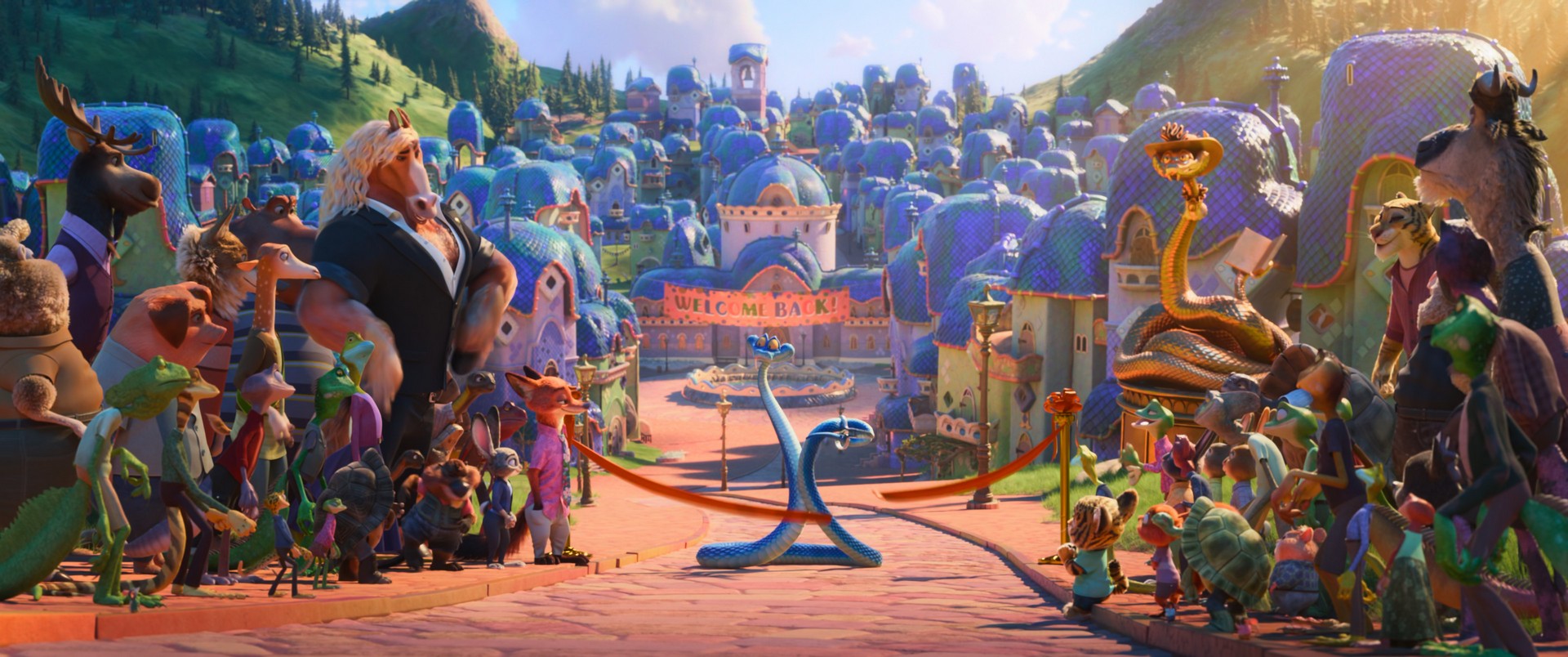
Reptile Ravine is the ancestral home of Zootopia's reptile population, located in a natural depression between Tundratown and Sahara Square. Designed over a century ago by Agnes De'Snake, the district was buried under snow when Ebenezer Lynxley framed Agnes and expanded Tundratown over the community. Its rediscovery in Zootopia 2 is the catalyst for the entire series, and it plays a crucial role in the series finale when Agnes's failsafe code is discovered within its depths.
Physical Layout
Geography
Reptile Ravine occupies a natural depression between Tundratown and Sahara Square. The terrain consists of gentle, grassy hillsides with terraced levels carved into the slopes. Climate-controlled barriers at the entrances keep the interior warm enough for cold-blooded residents while maintaining separation from Tundratown's manufactured cold.
Entrances
The west entrance is the primary approach — a wide, paved road sloping gently down into the Ravine. A climate barrier at the threshold creates an invisible wall of warmth. Signature buildings line both sides of the entry road, and a bronze statue of Agnes De'Snake stands on the right, holding up a book with her tail. No plaque or title adorns it — everyone who lives here knows who she is. The road leads to a central roundabout with a fountain, from which lanes split to all districts.
The east entrance is a newer addition, built during restoration to connect the Ravine to a transit hub linking it to greater Tundratown infrastructure.
Terraced Levels
The community is built on terraced hillsides, with different levels serving different species:
- Upper Terraces — Geckos; warming rocks, smallest paired doors, heat lamps
- Middle Terraces — Iguanas and chameleons; basking areas, vegetation zones
- Lower Terraces — Tortoises; gardens, round-roofed shell houses
- Valley Floor — Mixed species; market square, transit hub, community spaces
Architecture
Agnes De'Snake's original architecture is preserved throughout the Ravine, now integrated with modern systems added during six years of restoration.
Scale-patterned rooftops mimic reptile scales and shimmer under heat lamps. Diamond-shaped windows appear on all original buildings as a distinctive design element. Every building features paired doors — one large (for monitor lizards and basilisks) and one small (for geckos) — reflecting the community's commitment to accommodating all sizes. Turtle-shell houses with rounded roofs dot the lower terraces, used primarily by tortoises.
Modern additions include solar collectors integrated with century-old rooftops, updated ventilation and climate systems, a transit hub, a thermal plant at triple the original capacity, and new residential construction matching the original style.
Key Locations
Agnes De'Snake's Statue
A bronze statue of Agnes holding up a book with her tail stands at the right side of the west entrance. Added during restoration when the Ravine reopened.
The Lighthouse
The highest point in the Ravine, an old and weathered central tower that was originally the district's clock tower. It served as the entry point when Nick, Judy, Gary, and Nibbles found the buried Ravine. Agnes had a workshop beneath it, which collapsed from structural damage when the Ravine was buried.
Deep beneath the lighthouse — a shaft dropping at least two hundred feet, at the base of the foundation — lies The Root, Agnes's hidden control interface.
De'Snake Residence
Gary's house, located on the upper terraces. An original building carefully maintained as a time capsule, it contains the De'Snake family tree on the main wall (Agnes at the top, Gary near the bottom), a nursery room where generations of Gary's ancestors grew up, and shelves of journals, engineering diagrams, and personal effects. Agnes's drafting tools are preserved like relics. Gary's personal touches have been added without clashing with the history.
Market Square
A trading hub on the valley floor established during restoration. Traders from the Rainforest District bring fruit, local engineers trade heating crystals, and the square serves as the economic center of the restored community.
Transit Hub
New construction near the east entrance connecting Reptile Ravine to downtown Zootopia via public transit. A symbol of the community's integration into greater Zootopia.
Species Demographics
Snakes — particularly pit vipers — are the most common species, reflecting the De'Snake family's leadership in the community's founding and restoration.
| Species | Notes |
|---|---|
| Pit vipers | Dominant; Gary's family; community founders |
| Geckos | Upper terraces; significant population |
| Tortoises | Lower terraces; shell-roof houses |
| Iguanas | Growing population; middle terraces |
| Chameleons | Vegetation areas; colors shift with mood |
| Tegus | Multi-generational residents (e.g., Peron family) |
| Basilisks | Larger reptiles; use the bigger paired doors |
| Agamas | Community members |
Named residents include Gary De'Snake (blue pit viper; community leader and Agnes's great-grandson), Gary's family (mother, father, younger brother, younger sister), and the Peron family (tegus; three generations; among the first to return).
The Root
Hidden beneath the lighthouse, at the base of a foundation shaft dropping at least two hundred feet, lies The Root — Agnes De'Snake's most closely guarded invention. It is the master control interface that manages the foundational energy system powering every weather wall in Zootopia. The facility predates the modern weather wall grid.
Agnes never patented The Root, keeping it secret even from the patent office. When Ebenezer sealed the Ravine and built Tundratown over it, the location was lost. By Milton's generation, it was family legend rather than operational knowledge. Restoration crews never dug deep enough to find it. A hidden entrance beneath the lighthouse leads down through ancient tunnels — modern concrete giving way to old brick, then carved stone, then something older still.
Two codes govern The Root:
- BUILT_BY_LYNXLEY — Milton/Ebenezer's access code (corrupted from the original inscription)
- FOR_ALL — Agnes's failsafe and emergency shutdown code
The original inscription read "BUILT BY TWO, FOR ALL," but Ebenezer replaced it wholesale on the surface systems with the corrupted BUILT_BY_LYNXLEY and let time fade the original underground. The failsafe code is ultimately discovered on Agnes's console.
History
Founding
Reptile Ravine was originally a thriving settlement where reptiles lived alongside mammals. Agnes De'Snake, the true inventor of the Weather Walls, designed the district as part of her broader vision for Zootopia — a city where all animals could live together, including cold-blooded species.
The Burial
When Ebenezer Lynxley stole Agnes's patent, murdered his tortoise maid, and framed Agnes for the crime, he used the Weather Walls to expand Tundratown's snowfall over Reptile Ravine. The entire settlement was buried in snow and ice, and the reptile population was forced to flee Zootopia. Their history was erased as if they had never existed.
Rediscovery (Zootopia 2)
During the events of Zootopia 2, Gary De'Snake, Judy Hopps, Nick Wilde, and Nibbles Maplestick discovered the path to Reptile Ravine through the lighthouse. Inside Agnes's home, they found her original patent — proof that the Lynxleys built their dynasty on fraud. After the Lynxley family's arrest, Reptile Ravine was excavated and reopened. Reptiles were welcomed back to Zootopia for the first time in a century.
Restoration
Gary led six years of restoration: climate barriers installed at entrances, original buildings preserved and repaired, new construction added alongside the old, transit connections built, thermal systems expanded to triple capacity, and an east entrance added. Reptile families returned from across the region.
Season 5
In "The Godfather", Pawbert visits Reptile Ravine to search Agnes's journals with Gary. They discover a cryptic failsafe note: "The failsafe lives within our mission."
In "Tundratown Requiem", Icener's forces assault the Ravine, searching for code documentation and securing the lighthouse. The attack devastates the community Gary spent six years rebuilding — buildings damaged or destroyed, residents killed, the vipers who fought back among the casualties. Gary leads survivors through old tunnels to safety. Pawbert escapes with Gary's family.
In "Final Position", the final assault reaches The Root beneath the lighthouse. Agnes's failsafe code FOR_ALL is entered on her console.
W-Series
"The Call" establishes that the machine under the lighthouse is more than a control interface: it is the power source behind every wall on the grid, wired to the modern network through a translator that converts Agnes's units into the grid's, and still running under the concrete the city poured over her controls. The Ravine's own weather wall station is the last one called on the monitoring desk's roll, after Stations 65 and 66. On the night of the episode the grid's first deep pass on the restored station reads the resting plant so far below the modern scale's floor that the translator wraps the value to its top, and the Crisis Coordination Center spends an hour responding to a catastrophe that is not happening. The station itself is locked and dark with its alarm panel screaming and its night operator, Dewey, at the movies; a Counter-Terrorism Unit element cuts the door off its frame and finds nobody. The chief engineer, a tortoise who has run the station since the integration and can still read Agnes's original instruments off his own line into the plant, is at dinner with Gary De'Snake when Pawbert calls, and his reading is what stops the Center from firing demolition charges under Tundratown. There is no charge under the Ravine's own junction: it was surveyed in the post-Icener retrofit and never placed.
Significance
Reptile Ravine represents the original sin at the heart of the series. The Lynxley family's fortune was built on the erasure of an entire population. Its restoration symbolizes justice delayed but ultimately achieved.